
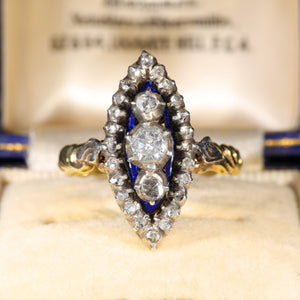
Georgian rings, made between 1714 and 1837, are among the rarest and most distinctive forms of antique jewellery. Because every piece was handmade, no two are exactly alike — and this individuality can make identification both fascinating and complex.
Understanding the construction, materials and design details of the period is essential when determining whether a ring truly dates from the Georgian era.
What Years Define the Georgian Period?
The Georgian period in Britain spans the reigns of four monarchs: George I to George IV, ending in 1837 with the beginning of the Victorian era.
Rings from this time pre-date large-scale industrial production. As a result, they were crafted entirely by hand, often using techniques that are no longer common today.
Are Georgian Rings Hallmarked?
One of the most confusing aspects of identifying Georgian rings is hallmarking. While hallmarking did exist, many rings from the 18th and early 19th centuries were either too small to carry full marks or have had marks worn away over time.
It is therefore common for genuine Georgian rings to have partial marks — or none visible at all.
What Metal Was Used in Georgian Rings?
Georgian rings were typically made in 15ct to 18ct yellow gold. Silver was frequently used over gold in gemstone settings, particularly for diamonds, to enhance brightness under candlelight.
Closed-back settings — where the back of the gemstone is enclosed in metal — are a strong indicator of Georgian craftsmanship.
What Gemstone Cuts Were Popular?
Diamonds were usually cut as rose cuts or old mine cuts, both shaped by hand. These stones have fewer, larger facets and produce a softer, warmer sparkle than modern brilliant cuts.
Coloured gemstones such as garnet, topaz, aquamarine and amethyst were also popular, often foiled behind the stone to intensify colour.
What Are Closed-Back and Foiled Settings?
Many Georgian rings feature closed-back settings, meaning the gemstone does not have an open back. Instead, a thin foil was sometimes placed beneath the stone to enhance its brilliance in low light.
This technique was designed specifically for candlelit interiors and is rarely seen in later Victorian jewellery, where open-back settings became more common.
What Design Features Suggest a Georgian Origin?
Georgian rings often display:
- Hand-cut gemstones with slightly irregular facet patterns
- Closed-back or foiled settings
- High-carat yellow gold
- Delicate engraved details
- Sentimental motifs such as hearts, eyes or memorial inscriptions
The overall impression is one of hand craftsmanship rather than mechanical precision.
How Does Wear Help Date a Ring?
Authentic Georgian rings frequently show signs of age consistent with two centuries of wear. This may include softened engraving, natural patina to the gold, and subtle irregularities in construction.
However, condition alone should never be used as proof of age. Expertise in materials and construction is essential.
Why Are Georgian Rings So Rare?
Because they pre-date mass production and many were later remodelled during the Victorian era, surviving Georgian rings are comparatively scarce.
This rarity contributes to their collectability and enduring appeal among those drawn to early craftsmanship.
When in Doubt, Seek Expertise
Identifying a Georgian ring requires careful examination of setting style, gemstone cut, metal composition and construction methods.
Explore our collection of Georgian rings to see authentic examples that showcase the defining features of this remarkable era.